
Bringing Medical Device Testing In-House Through Data Acceptance Programs

21 Sep 2026
A Flexible Approach Can Help Manufacturers Gain Greater Control over Testing, Certification Timelines, and Product Development
Medical device manufacturers are investing more heavily in their own testing capabilities. As products become more complex and regulatory expectations expand, the ability to conduct certain tests in-house can provide valuable control over development schedules, costs and certification planning.
Building an internal laboratory, however, is only part of the equation. A manufacturer may be able to perform a test and generate results, but that does not automatically mean the data will be accepted by a certification body, regulatory authority or target market.
Data acceptance programs help bridge that gap. Through a structured relationship with an independent testing and certification organization, manufacturers can establish that their facilities, equipment, personnel and procedures are capable of generating reliable test data that may be used to support certifications and market access.
Why Manufacturers are Expanding In-house Testing
Medical device development requires testing throughout the product lifecycle. Engineers may need to evaluate early prototypes, verify design changes, compare components, investigate unexpected results or prepare a product for formal certification testing.
Having appropriate testing capabilities on-site can make these activities easier to manage. Instead of shipping every sample to an outside laboratory and waiting for availability, the manufacturer may be able to conduct testing as part of its normal development process.
Faster access to results can be particularly helpful when product teams are working through multiple design iterations. A test failure discovered early may be corrected before the design becomes more difficult or expensive to change.
In-house testing can also provide greater control over scheduling. Manufacturers can coordinate tests with engineering milestones, production plans and regulatory submissions rather than treating testing as a separate activity at the end of development.
The potential benefits extend beyond certification. A well-managed internal laboratory may also support performance, reliability, durability and due-diligence testing. This is becoming increasingly important as medical technology advances faster than many consensus standards can be revised.
Performing a Test Is Not the Same as Producing Acceptable Data
The central question behind a data acceptance program is relatively straightforward: Can the results produced at the manufacturer’s facility be trusted and used for their intended purpose?
The answer depends on what the manufacturer is trying to accomplish. Data generated for an internal engineering comparison may be evaluated differently from data intended to support an ETL certification, CB Certificate, CE marking process or another market-access objective.
Different certification programs, countries and regulatory authorities may also impose different requirements. Some allow client-generated test data when it is produced under an approved program. Others may require testing by an independent laboratory or at a designated in-country facility.
For that reason, manufacturers should begin by defining the purpose of the testing. The applicable standard is important, but it is not the only consideration. The product, certification objective and intended markets all help determine whether in-house test data may be accepted.
This discussion should take place before the manufacturer makes major investments in equipment or assumes that a particular testing arrangement will support every planned submission.
Building Confidence in the Results
Data acceptance is based on confidence. The organization reviewing or certifying the product must be confident that the test was performed correctly, that the equipment produced accurate measurements and that the results can be supported.
Confidence building and correlation testing are two ways to establish this foundation.
During correlation testing, the manufacturer and the independent laboratory may perform the same test and compare their results. Consistent outcomes help demonstrate that the manufacturer’s equipment, test setup and procedures align with those used by the laboratory.
Testing may also be witnessed by qualified assessors. Observing the manufacturer’s personnel perform the test provides an opportunity to evaluate their understanding of the standard, use of the equipment, documentation practices and ability to follow the approved procedure.
This process benefits both parties. The independent laboratory develops confidence in the manufacturer’s capabilities, while the manufacturer gains assurance that its team is conducting the test in a manner that can produce meaningful and repeatable results.
What an Assessment Typically Examines
A data acceptance program looks beyond whether a laboratory owns the necessary test equipment. The complete system supporting the test data must be evaluated.
Assessors may examine the manufacturer’s quality system, laboratory procedures and document controls. They will also review whether the equipment is suitable for the intended tests, properly calibrated, and maintained within the required intervals.
Personnel competency is another critical consideration. Staff members must have the training, technical knowledge, and demonstrated ability to perform the tests included within the program’s scope.
These elements are similar to those evaluated within an independent testing laboratory operating under ISO/IEC 17025 principles. Once approved, the manufacturer’s facility can function as an extension of the certification organization’s laboratory capabilities for the defined scope.
Approval is not a one-time event. Periodic assessments help confirm that personnel remain qualified, calibrations are current, procedures are followed and the quality system continues to support reliable results.
Supporting more than Final Certification
The discipline required for a data acceptance program can improve testing throughout product development.
When laboratory personnel have demonstrated competency and equipment is properly controlled, manufacturers can have greater confidence in the results of internal design verification, performance and troubleshooting activities. Even when the data is not submitted for certification, the laboratory is operating according to established processes designed to improve consistency and repeatability.
This can help manufacturers identify potential compliance problems before formal testing begins. It can also provide useful information when evaluating alternative components, reviewing product changes or developing a new model within an existing product family.
For medical devices that are large, difficult to transport or dependent on specialized infrastructure, in-house testing may provide an especially practical solution. Certain respiratory, anesthesiology and medical gas systems, for example, may be easier to evaluate at the manufacturer’s facility.
Component and subassembly testing may also be included where appropriate, giving manufacturers additional options for managing compliance earlier in the design process.
A Program Does Not Have To Be All or Nothing
One of the most useful aspects of a data acceptance program is its flexibility. A manufacturer does not necessarily need to perform every applicable test or take responsibility for the entire certification process.
Some organizations establish an internal capability for a single test that is frequently needed or logistically difficult to outsource. Others have sophisticated laboratories and want approval for a much broader selection of standards and test methods.
Responsibilities can be divided according to the manufacturer’s resources and objectives. A company may perform approved tests in-house while relying on the independent laboratory for other evaluations, technical review and preparation of the final certification report.
The outside laboratory also remains available when circumstances change. If equipment falls out of calibration, a facility becomes temporarily unavailable or a test falls outside the approved scope, the remaining work may be transferred to an Intertek laboratory.
The scope can evolve as well. When a new edition of a standard or an additional particular standard becomes applicable, the manufacturer and laboratory can work together to evaluate the new requirements, equipment and personnel competencies before expanding the program.
Connecting In-house Testing with Global Market Access
Client-generated test data can support a broad range of certification objectives when the applicable program and market permit it. These may include the ETL Mark for North America, CB Scheme activities, evidence supporting CE marking and various performance or international certification programs.
For products intended for the United States, Intertek’s status as an Occupational Safety and Health Administration (OSHA)-recognized Nationally Recognized Testing Laboratory allows qualifying in-house testing to support ETL certification through our SATELLITE program. The fact that testing occurs at an approved manufacturer facility does not prevent the product from earning an independent certification mark, provided the work is performed within the established program and all certification requirements are satisfied.
Still, global acceptance should never be assumed. Requirements must be reviewed for each product and destination. A test report that supports access to one market may require additional review, witnessing or testing before it can be used elsewhere.
Early planning helps manufacturers understand where their internal capabilities can provide the greatest benefit and where independent or in-country testing will still be required.
Preparing for a More Complex Testing Environment
Medical device testing is unlikely to become simpler. Manufacturers must account for expanding requirements related to electrical safety, electromagnetic compatibility, software, cybersecurity, artificial intelligence, sustainability and other emerging concerns.
Data acceptance programs are not intended to replace independent certification. Instead, they create a framework in which manufacturers and independent laboratories can share testing responsibilities while maintaining confidence in the resulting data.
For manufacturers with recurring testing needs, appropriate laboratory resources and a commitment to quality, this approach can provide greater flexibility throughout product development and certification. The most effective program begins with a clear understanding of the product, the planned tests and the markets the manufacturer intends to reach.
Intertek can help medical device manufacturers evaluate their existing laboratory capabilities, identify suitable testing scopes and establish customized data acceptance programs via SATELLITE™. By aligning in-house resources with independent technical oversight, manufacturers can make better use of their testing investments while preserving the confidence required for certification and global market access.

You may be interested in...
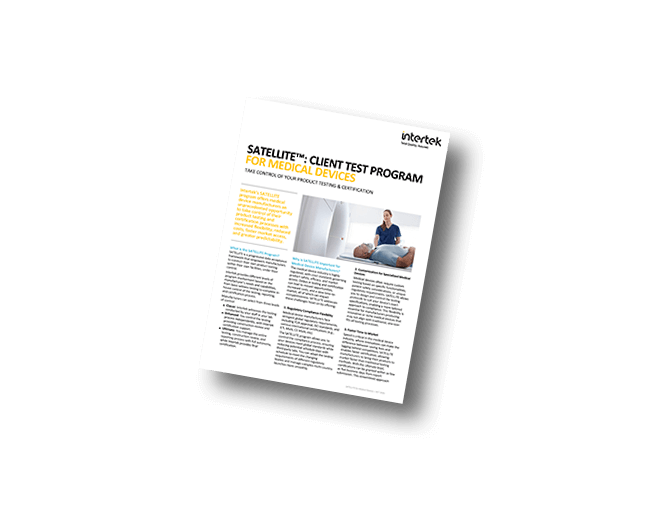
SATELLITE™ Client Test Program for Medical Devices
Discover how Intertek's SATELLITE™ Client Test Program can revolutionize your medical device testing and certification with unmatched control, cost savings, and speed to market.
SATELLITE™ Client Test Program For Medical Devices
Product compliance testing in your own labs and on your own schedule while obtaining our market-leading Certifications.